12/26/2025

Lord's Day Primer

This is a "Lord's Day Primer" I have borrowed and added to. Pretty sure I saw it on a SM post, maybe "X"? But, I can't remember who the original credit should go to. Essentially, a reminder and a pattern to hopefully get a believer to focus on prayerful preparation for Sunday worship and gathering.

The eve of the Lord’s Day is here:

Consider these passages as you pray:
Isaiah 6:1-4; Psalm 51; Hebrews 12:18-29; Revelation 4-5

Pray for God to be glorified in all things. (Isaiah 6:1-4)

Pray for the church (saints everywhere):
- the missionaries
- the needy
- the growing

Pray for your pastors and elders:
- preparing the sermon
- for their family's health and well-being, and for their perseverant support
- for their joy in shepherding
- for protection of their soul as they prepare, deliver, and serve

Pray for your family.

Pray for personal discernment of temptation and sin and for repentance and forgiveness. (Ps 51)

Pray to be ready to worship in spirit and in truth. (Heb 12:18-29)

Pray for the Word of God to be faithfully preached and well received. (Revelation 4-5)

Pray for all those that hear the Word today:
- the saints to be nourished, encouraged, and strengthened
- the lost to hear the gospel, repent of their sins, and believe in the gospel.

7/03/2023

Systematic Theology: Manual of Christian Doctrine - Berkhof 000

This is an introduction to what I hope to be a "book study" series on Louis Berkhof's Manual of Christian Doctrine. It will focus more of the points of the book as opposed to the book itself. At the time of this entry, I have recently started this book and would like to use it for a small group/discipleship study.

Essentially, this book is one of many "Systematic Theology" titles; however, it was initially written for the "high school" and college student in the early 1900s. The author mentions (in the preface) that after his "Systematic Theology" work was published, he was asked to compose such a work and the result was this "brief manual" (241 pages).

Noting that he has a "Systematic Theology" work, I may end up switching to that title (1040 pages, maybe not...)

Ideally, I will focus on the headings/subheadings of each section and primarily discuss the scripture. Basically, this will be my online notebook for this study; because there can't possibly be anything new I could add to this thorough work.

#SoliDeoGloria

GB, SM: Breaking Up

Good-bye, social media... (this was initially composed 1/15/2018)

It's really not difficult to say "good-bye" to social media. At least, not for me... anymore.

In this day and age, that day being in the late teens of the 21st century and that age being the age of instant global communication, I am noticing as much, if not more, negativity in society than I suspected or maybe even expected. I think the key term is "noticing"; because, if I look back at the popular desires of society in the last 25 or so years, I could make a case that the desire for self promotion and demotion of others has always existed.

Take two:

It's not you, it's me... well, it may actually be you, but I'm making this decision, so, don't take it as a rejection or a loss, you will find (and already have) other "fish in the sea"...

I'm going to take a break from consuming Social Media; at least from the SM that makes it so easy for anyone to blurt out how they feel at the moment (Facebook, Twitter, and Instagram). I'm still going to watch YouTube for inspiration and education; but, I hope to be more of a producer of online content than a consumer, via this blog. (This isn't to say that I'm going to start making videos, as I don't have anything visually interesting to post in a video and I pretty much refuse to make a video of just me talking about something.)

If you haven't read my disclaimer for this blog, tl;dr: Just my opinions and observations from my perspective; nothing authoritative, since I have no authority.

Since I have been a consumer of Social Media more than I, or anyone should, normally consume (2 to 3+ hours a day); I have noticed more negativity than I like to see. There must be some sort of psychological or sociological term for it; but, I would consider it to be termed something like the "opinion-line affect". If you aren't familiar with an opinion-line, it is usually an anonymous outlet for the general public to voice an opinion on any matter the person chooses. I think local newspapers started this type of "service" and with the evolution or improvements in technology, the opinion-line went from simple hand-written notes to quick phone calls, and now, people can easily give their generally heated opinions with the simple swiping, typing, and posting via smartphone (or mobile devices). 

Addition 7/3/2023 - I think I took a break from SM, and have recently been thinking about making a SM post about taking an indefinite break; I just want to be able to leave a line out there that could be used to glorify God and encourage others to seek Him. So, I'm still brainstorming what to post and how to make my SM usage only as an export: produce, not consume.

Addition 12/26/25 - about a month or longer ago, I deleted all my SM accounts. Haven't missed it. Better for it.

Twitter Responses: "The Bible says... women... disabilities... stoning..."

Subtitle: Be Holy

A user replied to one of my "REPENT" replies:

"The Bible also says that women aren't allowed to speak in church. (1 Tim 2:12). Also that people with disabilities should not approach God. (Lev 21:16-21). To also take your disobedient children and let the neighbors stone them to death. (Dt 21:18-21)" - 2023/06/02

I'm finally getting around to responding (and not reacting). One of the "concerns" of the respondent was being told "go to church and find out"; but, I think that would be a careless response (and I don't think I would ever suggest that).

Bible Gateway LSB translation of 1 Tim 2:12, Lev 21:16-21, Dt 21:18-21

Let's look at these in order of textual presentation (how they are ordered in the Bible). Also, let's look at the context, otherwise we could easily have a "sect" of "Christians" literally crying all the time because of a single verse like John 11:35 "Jesus wept."


Leviticus 21:16-21 (LSB)

16 Then Yahweh spoke to Moses, saying, 17 “Speak to Aaron, saying, ‘No man of your seed throughout their generations who has a defect shall come near to offer the food of his God. 18 For no one who has a defect shall come near: a blind man or a lame man or he who has a disfigured face or any deformed limb, 19 or a man who has a broken foot or broken hand, 20 or a hunchback or a dwarf, or one who has a defect in his eye or eczema or scabs or crushed testicles. 21 No man among the seed of Aaron the priest who has a defect shall approach to bring near the offerings to Yahweh by fire; since he has a defect, he shall not approach to bring near the food of his God.

The full chapter is linked to biblehub.com and it's helpful to read commentaries or at least information about a specific "book" in the Bible. There are many commentaries; but, for the sake of "post size", I'll only reference the "first" in the list from this site (Ellicott's) and do the same for the next two referenced passages.

The commentator mentions that this book is God's instruction for His elected people (Israel) and how they are to conduct themselves in their interaction with Him as well as with each other, specific worship activities and duties, as well as with the environment (land). According to the Bible (from the beginning and to the Revelation), God is perfect and Holy. He calls (directs/instructs) His chosen people to be "holy" and "set apart" (unique and not like) from the rest of the world. Chapter 21 is directed toward the "specific priests", requirements, qualifications, strict duties, etc. Only a specific "lineage" (Aaron's seed) was allowed to serve as priests, and within that lineage, only specific men who could meet the restricted requirements could serve. If we look at Exodus (19), God commanded Moses that nobody, not even an animal, could come up or touch the border of the mountain (Sinai) where He (God) was "resting upon". The Bible teaches that God's holiness is pure, true, and so great that that anything or anyone less than His holiness could not be in His presence nor near Him, unless He allowed. God tells Moses to create a border so that none of the people or the livestock would come near and die. He laid out "perimeters" (boundaries and regulations) for the safety of His people. If we read Lev 19, noting verses 2-4, we can see God's call for them to "be holy" for He is holy. Again, the entire chapter of 21 is specific to the priests that are supposed to carry out the special and specific duties for worship. So, you have a specific people chosen by God called to be "set apart" from the rest of the world, and within that people, a specific "lineage" called to be set apart from the group, and within that lineage, a specific "office" to be held by certain qualified individuals.


Deuteronomy 21:18-21 (LSB)

18 “If any man has a stubborn and rebellious son who will not obey his father or his mother, and when they discipline him, he will not even listen to them, 19 then his father and mother shall seize him and bring him out to the elders of his city at the gateway of his hometown. 20 Then they shall say to the elders of his city, ‘This son of ours is stubborn and rebellious; he will not listen to our voice; he is a glutton and a drunkard.’ 21 Then all the men of his city shall stone him, and he will die; so you shall purge the evil from your midst, and all Israel will hear of it and fear.

The "book of" Deuteronomy is somewhat of a recap of God's law for His people, with a bit more specific explanation (exposition) and application. 21:15-17 discusses the "firstborn's birthright", and this section of verses (18-21) discuss what should be done with an incorrigible and obstinate son. We must remember what happened at the "fall of man", in the garden: God gave a command to not eat of the tree of knowledge of good and evil, otherwise man would die. Man refused to obey God and affected all of creation with death and decay. The first people, easily looked at as a type of child/children to God, rebelled; this rebellion negatively affected the rest of creation (ruined all the good God had made). We should consider modern true stories of parents and children in which a child's lack of obedience caused a long-term and permanent problem for the legacy of the parents; think of the "extreme" of being the parent of a tyrant who was primarily responsible for the death of millions of people, we might understand how utter disobedience can be a problem for a family, let alone for a people group. As mentioned earlier, God calls His people to be "set apart" (holy) as He is Holy; therefore, when one disobeys and puts his family, let alone his people, at risk, the serious problem must be seriously dealt with. Note that the description is of a son who "is a glutton and a drunkard". Clearly, this should be applied to children of a certain age: those that were able to drink and be considered lazy (those that do not take care of independent [viable adult] responsibilities). A commentator notes that a drunkard and a glutton will eventually run out of money and become hungry; their hunger will turn them to a life of crime, causing them to be even more dishonorable, let alone causing problems for the community. This type of "warning" about what should happen to one such "child" is a good motivation for the parent to work hard at properly raising children and good motivation for the child to work hard and honestly obey and honor his parents. If and when a parent was truly diligent in "bringing up" the child, and yet the child grew up to be vehemently disobedient, there was a consequence, a major one in our eyes; but, a proper one in the eyes of the Holy God. Personally, I can't imagine being the parent in those days that had to report his son; but, I also know God is perfectly good and completely worthy of obeying, which is why I would hope that I would have been diligent in parenting (Dt 6).


1 Timothy 2:12 (LSB)

12 But I do not allow a woman to teach or exercise authority over a man, but to remain quiet.

The 1st "letter" to Timothy is written by the apostle Paul as a reminder and encouragement to continue to teach what God has said, what to refrain from, qualifications for leadership and individual roles when it pertains to relating to each other, especially within the "body" of the church. By this time, Paul has already instructed the "church" at Ephesus (which is where Timothy is at this time) on individual relations and roles specifically as husbands, wives, and children, let alone those in specific social roles and the basic behavior of all Christians no matter their "social" role. At this point in the letter to Timothy, Paul has already warned about those that teach false instruction, and against paying attention to myths and endless genealogies. These "myths and genealogies" cause wasteful speculation and distract from the Truth, let alone from productive activity, whether it is learning truth or serving others. He has also reminded that God's Law is good, as long as it is used properly (lawfully): pointing to the existence and need of a savior - Jesus. Paul identifies himself as having needed the law to show him his need as well as being thankful to not only be shown; but, to also be used as an example of God showing mercy and grace to even the worst sinner (Paul). With this clause in mind, he starts with general instruction to all "members" and then specifically to women. First to remind women that true beauty is found in wisdom, good work, and godliness and "external" beauty is secondary to "spiritual" beauty. We should have a good understanding of what happened in "the fall" (Gen 3) as well as Proverbs 31 (esp vs 10-31) and the instructions in Ephesians - might as well include the entire Gospel - so that we can see that this is not a degradational statement or instruction, especially if we continue to read the result of spiritual self-control. My opinion is that when people read things that sound "restrictive" and have a reactive "that's unfair" attitude, they show a desire for self instead of a desire to understand. It's no different than today's Western culture of adolescents not wanting to comply with a parent's authority, especially for the parent that wishes the absolute best for the child in physical, emotional, mental, and spiritual health and future abundance.


I feel like there should probably be more to this response. I can see where there would be a lot of "rebuttal" in regard to the text; but, I don't think the rebut would be on task with the initial lines of text discussed.

Op: UFOs, Aliens, Telepathy, and Conspiracy

Initially composed 2/23/23-3/2/23 with a small addition at the end

Gen 1, 2, 3; Col 1:16; dan 10; 1 Sam 16:14-23, 1 Sam 18:10-11, 1 Sam 19:9-10; Luke 22:3; John 13:27; Rev 13; 17; Lv 19:26; Dt 18:10,14; Acts 16:16-18; Matthew 4:1-11 LSB

In reference to the following podcast episodes as well as the idea of “extraterrestrials from outer space or other dimension(s)” and on telepathy. 

Shawn Ryan Show (SRS) #48: Dr. Steven Greer

Sci-Fi Christian (SFC) #1085: “Kooky Cupid”

In the SRS with Dr. Steven Greer, the discussion is about U.S. and world government awareness, coverup, and weaponization of information on UFOs, “aliens”, and “alien technology”. There is also a discussion on how these life forms communicate with each other as well as allegedly with us (humans). The guest refers to a documentary titled “Close encounters of the 5th Kind” which elaborates more on the communication piece. The basic idea is that these “beings” communicate with a form of telepathy; but, in more of a sense of simultaneous time and space. Maybe not quite an “omnipresence”; but, an ability to be or project onto a specific space in time and time in space (my words/conjecture).

In the documentary, you see depictions of people potentially attempting to communicate with these beings in an Eastern meditative posture; think of the stereo typical “lotus” sitting position and thumb to whatever finger hand positions, etc.

In the SFC episode, there is a discussion on the probability of telepathic abilities (and experiences) in all humans, and even living creatures, pointing out various experiments and their resulting data. There is a hypothesis that “telepathy exists” and one should “open their mind up to it” and to “believe in the possible”; however, still not exempting the “supernatural” such as the existence and influence of the Holy Spirit and demons. Ending with an encouragement to try the “stare at someone to see if they can ‘feel’ the stare and potentially respond/react” experiment. (My huge criticism for one of the hosts is his experimenting with this when he’s supposed to be focusing on the “eucharist” at the time - let alone almighty God - but I digress).

After listening to the SRS episode and watching probably half of the documentary, I started thinking about this desire by Dr. Greer and people of the like: that there are “others out there” and a wish to communicate and potentially a hope to be “saved” by them (the “saved by them” part is my conjecture, I don’t think anyone came out and said this; but, it sure seems to be a high probability that this is one of the desires). While this is an interesting thought: there are other worldly beings we can interact with that are more intelligent and “advanced” than our current state; this is a very dangerous thing to not only spend much time and energy on (investigating and investing in), but also very dangerous to believe and continue to seek, if the Bible is really true and God is who He has said He is.

Recap of the Bible:

God, existing in three persons, but one unique being: Father, Son, and Holy Spirit, all co-equal, co-eternal, coexistent, and co-powerful (is that even a term?).

God created all things in existence, through the Son, for the Son, things seen and unseen. (Gen 1-3, Col 1:16)

Satan and a third of the angels rebelled and were cast out of heaven (God’s presence).

Man (human kind) was created in God’s image, as the final creation and a final “very good” work of creation.

Satan desired to destroy God’s “very good creation”, being a non-threatening deceiver to Eve and Adam; and he continues to lie, seek to destroy God’s people, and attempt to lead the whole world astray; even appearing as an angel of light.

God desired to reconcile His fallen creation to Himself that could only be accomplished through the cross.

Jesus died (on the cross), was buried, raised again, ascended into heaven, and will come back again to make all things new.

Now, if we know, understand, and believe (trust) these things that the Bible has clearly said, then we have to take into account the true reality of our natural and the “invisible” world. Our natural world (things we can physically experience and either discover or explain) contains truly great dangers to our eternal existence (our soul) such as our selfish “fleshly” desires and narcissistic passions (temptations that lead to sin). The “invisible” (spiritual) world also contains dangers to our souls; however, I surmise most of them to be influential dangers that lead to “natural world dangers” (acts/works of the flesh), think also of Screwtape Letters examples of influencing or giving the human an idea or thought to distract from God. Even the Bible is clear on specific “supernatural influence” on the natural world (Daniel 10 “Prince of Persia and of Greece”; 1 Sam 16, 18, 19; Judas Iscariot, Revelation 13 and 17, etc).

Perhaps, the idea of “extraterrestrial beings” and the ability to communicate with them can draw the focus off of God, let alone prompt another “explanation” to the “natural world” about “other-worldly” experiences. Much like the old argument of “the Greeks blamed unexplained events on ‘gods’”; relating the Biblical belief as another “explain away the unknown, based on superstition and mythology”. If we have read and studied New Testament, we can recall that satan is a liar and deceiver, trying to lead the whole world astray. What better way than to convince the world that God doesn’t exist and neither do demons, that it’s just trans-dimensional beings/existence that can be accepted into the “natural world” of explanation? Not only an explanation, but a notion that any potential other-worldly beings are “friendly aliens here to help, wanting peace” (angel of light?).

Let’s switch over to the “worldly” or the “physical”. Let’s say that all the “alien evidence” has all been truly spoofed (by the world elite); but, the public are so convinced, they cannot shake the lie. What better way for a world government to weaponize and enslave people, as well as the government, or power group to be used to convince the majority population that there is no God and how “we need to treat these beings as a threat”. Then, a tribulation against Christians can be even more popularly executed because “they refuse to believe in this real threat and refuse to comply for the needs and good of the rest of the world” and “their religious worldview is a threat to our world security”. (It’s not hard to relate this to any recent “threats”, and it’s not hard to inadvertently make this discussion go off the rails into “conspiracy” theory, old and current/new; but, that’s not what I’m trying to do here.) Again, the selfish desires of the potential “in-power elite”, influenced by the notion to impress upon others of the “ET” existence to gain more power which is an easy influence of the invisible spiritual world, especially on those that want to destroy God’s elect. Personally, we (Christians) should welcome this scenario, #OneDayCloser.

Ok, back to the “paranormal/supernatural”. Considering that there is a spiritual-world influence, especially in the negative for those that do not have the Holy Spirit; why wouldn’t or shouldn’t the Christian believe that any potential “telepathic” abilities are only the result of demonic influence? One could speculate that the activity of prayer is a type of meditation leading to a “tapping into” telepathy. Not only are we literally communicating to our God, but we may be so focused on Him and/or those we are praying for, we may be putting some sort of influence on or towards someone we are praying for. Similar to how the SFC episode talked about the “staring experiment”, and the popular “sending good thoughts and vibes”; maybe hyper-focused prayer can cause a “supernatural” connection between individuals, causing a “feeling” in the one being focused on. I do not say this as a hypothesis, nor am I looking to use this to excuse a “test” of this nature. If we (Christians) are to adhere to Biblical proofs and view the world through a Biblical lens; then we cannot find any evidence nor encouragement to attempt such things. If anything, we see discouragement to attempt to be part of such activities. In today’s (3/2/23) episode of Apologia Radio Live, they talked a little about Dr. Greer (which personally got me excited because I was already thinking about this on 2/28) and the occultic practices of remote viewing and out of body communication, etc. They referred to God’s warning or commandment against “spirituality” in regard to divination, soothsaying, attempting to contact spirits, sorcery, mediums, etc (Lv 19:26; Dt 18:10,14).

In abrupt closing: from a biblical worldview, we must understand and remember what God has commanded, how we are to abide in His word, and be aware of the signs of the end times which are meant by the enemy's tactics of persecution as a means of destroying God’s elect, but inadvertently all in God’s plan. This being said, when we pay attention and identify things and ideas that attempt to either distract us from God’s will or to slowly lead people away from focusing on God’s glory, we will be able to use discernment in how to navigate and respond to such ideas.

Side note: as I’m thinking about this, I can’t think of any Biblical evidence for evil spirits manifesting themselves to the human, except for in possession (allowed by God for the purpose of God getting glory by the evil spirits being cast out and to give validity to Jesus and his disciples) and then in the garden of Eden or to Jesus in the wilderness; although, we even see when Paul casts out a demon from a girl that was used to tell fortunes as a business for the “owners” in Acts 16:16-18.

Addition: I recently found a fun and interesting podcast called "The Haunted Cosmos" which at this time, I can easily recommend.

6/13/2023

Twitter Q&R: Condemning Lifestyles

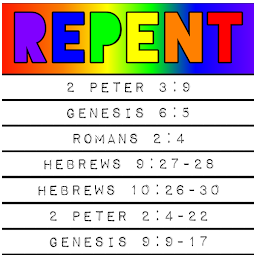
A response to my “REPENT” twitter response to every “Pride” post from an organization/entity/public figure, not necessarily to "regular users"; but, so that they too would see the verses and maybe look up the verses.

(2 pet 3:9; Gen 6:5; Ro 2:4; Heb 9:27-28, 10:26-30; 2 Pet 2:4-22; Gen 9:9-17 LSB - The Lord is not slow about His promise, - Bible Gateway)

One "regular user" initially posted “Check out Matthew 6:1” which is about not “showing your righteousness to others”. I replied, sarcastically, “Nice of you to think I’m righteous; but, please check out the verses ref’ed in the post (I added a link to biblehub.com and quoted the first verse from the image 2 Pet 3:9)

Original Post: https://twitter.com/carmenICT/status/1667930127173402626?t=i8zY3jT3Q-dJ40AXJ4Krlg&s=19


User’s Response: “Wasn’t calling you righteous. Why do so many people (like you) who quote the bible use it to justify their hatred toward queer people? You also didn’t respond to the verses I shared in your other tweet like this. 1 Tim 2:12, Lev 21:16-21, and Deut 21:18-21. (I'll respond to these verses in a later post)


Me: (Initially) Sorry, I honestly didn’t see any of your other replies, see my screenshot of the notifications. I’d like to see your replies…


User's Response: "It was 9 days ago on 6/2 on a KSN article about pride events"


Me: Can you share what, about those, verses I posted were “hatred toward ‘queer’ people”? Did you look them up? Then I mentioned about posting them verbatim; however, I figured it was better if the user looked them up instead of taking my word for it.


User's additional reply: I have other thoughts on this but I will spare them so I don’t get told “go to church and find out yourself” (and shared a screenshot of a composed post that is more than likely “copy and pasted” article containing the following)

You are using those verses to say that someone whose identity does not align with yours are sinful and are apparently “condemning” others into that “lifestyle”. That they need to find their “true identity”. All the queers are offering is acceptance to others. Another verse that is commonly used to spread hate is 1 Cor 6:9-10 as well as Prov 16:18-19, particularly against the LGBT community and pride month. In Heb 10:30, it is clear that it is up to God to judge his people, so why do you feel that it is your duty to command repentance? When I meant Mt 6:1, it says not to practice your righteousness in front of others… And you are here. Sharing verses. Demanding them to turn away from who they are and to follow Jesus. I have another question. Should we follow God or Jesus? I understand that he is the son of God, but why do some say to follow God/the Lord and others say to follow Jesus? What about those who are queer, like myself, but still hold belief? Is that still deliberately sinning? If a gay person has faith in Jesus, do you think they can still go to heaven? I thought it was to have faith in Jesus was all it took.


Most verses mentioned, starting with the 7 initial verses in the original post: 2 pet 3:9; Gen 6:5; Ro 2:4; Heb 9:27-28, 10:26-30; 2 Pet 2:4-22; Gen 9:9-17; Ro 1:18-32; Genesis 1:26-30, 2:18-25; 1 Cor 6:9-10; Prov 16:18-19; Exodus 20:1-17; Romans 10:5-21; Mt 7:15-23; Mt 28:18-21; Jn 14:1-15; Jn 3:5-6, 17-21, 12:44-50; James 2:14-26; Mt 6:24; Jn 3:36; Ephesians 5:1-21; Colossians 3:1-17 LSB - The Lord is not slow about His promise, - Bible Gateway


I tried to break down each question/comment so I could address each one individually and will tag each comment or question with a “C:” or a “Q:” and my response with "A:"


C: You are using those verses to say that someone whose identity does not align with yours are sinful and are apparently “condemning” others into that “lifestyle”.

A: The first verse (2 Pet 3:9) shows how God is patient and that we shouldn’t abuse His patience and that we should take advantage of the time and opportunity to repent from our sin and turn to Jesus for forgiveness and live to glorify Him alone.

The second verse (Gen 6:5) is part of the chapters (6-9) where we see the global flood, and this verse shows the reason for the flood.

R 2:4 is from a section that explains “God’s Righteous Judgment”; specifically, this verse reiterates 2 Pet 3:9 and mentions that God’s patience is kindness that should lead everyone to repentance.

Heb 9:27-28 mentions that all will die and then be judged and when Jesus comes back (returns) in judgment, it is not to judge those who are truly His (those eagerly waiting for Him)

Heb 10:26-30 is a “warning against willful sin”. Basically, if we know the truth (what God has said in His word) but keep living in sin (continually and willfully sinning, striving after the things God has told us not to especially after the fact that Jesus has been revealed as who He is [God incarnate]), we are refusing the self-sacrifice Christ has made on our behalf, refusing God’s grace and mercy, and deserving the wrath He has promised for those that willfully deny Him.

2 Pet 2:4-22 describes how God not only righteously judges; it describes those that deserve judgment, especially those that have “known” the truth about Jesus.

Gen 9:9-19 describes where the rainbow came from and what it truly stands for: God’s promise to not judge the world by flood. And a reminder that God is faithful in what He has said, done, and will do: bring a permanent righteous judgment and rescue those that are His.

As a matter of fact, I don’t think the condemning lifestyle you mentioned is even once referenced in these verses. These verses were used to show that God is patient toward all sinners; but, His patience does run out and we shouldn’t abuse His grace and mercy.

Perhaps I should have referenced Ro 1:32 which talks about not only are sinners at fault for their own sin; but, they are encouraging others to do the same, which is what the federal, state, and local governments and institutions, as well as “media outlets” and “celebrities” are doing with the “pride month”: tolerating/accepting, encouraging, and celebrating actions against God.

If I really wanted to be specific about the “lifestyle”, I would have at least posted Ro 1:18-32


C: That they need to find their “true identity”.

A: Genesis 1 (26-30) as well as 2:18-25 shows God’s initial intent for the “design” of all humans: made in His image (has emotion, ability to reason, and autonomous will up to a certain ability), and that we were created for His specific purpose: enjoy the life and work He gave us and to obey Him so that we would not die. However, because the initial humans (Adam and Eve) disobeyed God, their sin caused all things to decay and become corrupt, including their own nature and “innocent” desires. Because of the corruption to our nature and intended design, we all have a desire for self and we naturally turn away from God and the truth - this is a “sin nature”. We don’t want to accept the truth that we are all destined to be judged (more like sentenced) for our rebellion; in all honesty, none of us are truly innocent due to our now sinful nature. However, there is an option, we either continue in our rebellious nature until our final sentencing (the judgment after death), or we recognize God’s willingness to step into our reality, live perfectly innocent, die truly innocent to pay for our sins, raise Himself on the third day, and ascended into heaven and is coming back in judgment, and we put our identity in Him alone, making our selfish nature (the old nature) die and living in and to the glory of Christ. This should be our true identity: in Jesus Christ.

I don’t think anyone’s true identity or primary definition of who they truly are should be based on sexual orientation or desire, not even “origin”.


C: All the queers are offering is acceptance to others.

A: Please define “queers” and be careful to insinuate an entire group. I don’t want to impose a definition; however, I will answer based on my understanding of the term or what seems to be the “social opinion” and perhaps is being implied by your post. If you mean “queer people” are all LGBTQIA+ and vice versa; then, what we see in the media and imposed celebratory recognition such as days, months, symbols, and “education” does not tolerate or accept the truth of the Bible, that God truly exists, nor does it accept the possibility (and seemingly more probability) that the general public does not want to “celebrate” or be reminded of such “lifestyles”; let alone the fact that many do not want their attention and finances to go toward such lifestyles, and even more important, that they do not want their children exposed to to such lifestyles. If “Christian demonstrators” and “evangelists” are at a “pride event” and either quietly holding a sign such as the initial image posted, or they are respectfully speaking against the lifestyles, do all members of the LGBTQIA+ lifestyle accept the Christians’ presence and what they are doing?


C: Another verse that is commonly used to spread hate is 1 Cor 6:9-10 as well as Prov 16:18-19, particularly against the LGBT community and pride month.

A: The Proverb is mentioned because “pride” is mentioned. We are designed and given life to glorify God and not ourselves or ourselves on the account of an identity with something or someone. Pride is classically defined as (paraphrasing) having admiration for oneself, whether in an accomplishment or in an identity. We can see many instances in the Bible where pride, which is a gateway and root of vanity and self-praise. We either praise and worship God, or we praise and worship ourselves. This is a form of idolatry and spoken against in the first commandment (Exodus 20). To put oneself at equal or above God seems to be the utmost rebellion against a perfect creator, God and is an outright slap to His face. Should we do this to the One who has created, is holding all things together, and is coming back in judgment?

1 Corinthians is a “letter” to the believers at Corinth and an applicable reminder to all believers that we are not to be any one of the unrighteous listed in that verse otherwise we would not inherit God’s kingdom. Verse 11 (not referenced by you) reminds all believers that they have once been at least one of these unrighteous; but, are to no longer have that “identity” because they are now identified in Christ.

Warnings about the truth should not be considered “hate”. However, if someone is “justifying” their “hatred” toward others by using scripture; that is blasphemy and against the 3rd commandment. I called the organizations and entities to repent and to no longer encourage others to sin.

Unfortunately, “pride month” has such a marketing and political campaign to what seems to be a requirement to celebrate something that not all agree with, there is definitely going to be outspoken pushback. I don’t agree with violent protest nor vulgar demonstration. However, one should not claim “hate” or “anger” when such words aren’t clearly being used or implied. I do wonder what the majority of the “LGBT” community think about all the “Pride demonstrations” and governmental encouragement and attention being drawn to the “community”. As if this month and all the marketing/media clearly defines and represents what the “community” truly believes and stands for. Of course, just because a majority’ opinion is one way, doesn’t mean the opinion is inclusive of all of that group, right? Christians can have this same issue; however, we (Christians) have the infallible Word of God to rely on and use as a standard and authority, we can’t simply make the Bible say something it clearly does not. Another “side question”, what do you think of the “viral” footage of the “White House Pride demonstrations”?


Q: In Heb 10:30, it is clear that it is up to God to judge his people, so why do you feel that it is your duty to command repentance?

A: Yes, God will judge His people and He doesn’t want anyone to perish (be sentenced to eternal death) [2 Pet 3:9]. However, how will anyone know about impending judgment if we do not warn others? Romans 10:5-21 discusses this.

To judge, in the sense of condemnation, is to sign and seal a final sentence. I don’t know anyone’s heart, but my own; therefore, I cannot tell who is and will be saved versus who will not. Nor do I want to say anyone is definitely condemned; however, we are called to warn others about the final judgment and that none of us know when our life will be over and then it will be too late to repent and seek after God. Jesus uses the analogy of recognizing a tree by its fruit (Mt 7:15-23); therefore, if I simply recognize someone who is going to be judged by God according to His standard and simply say, “yep, their doomed” and keep to myself, I am not displaying any love for that “doomed” person and essentially wishing them to an eternal death. It’s analogous to letting a cyclist continue down a road that leads to a drop-off cliff.

Also, the fact that Jesus gave His followers a “commission” (a commanded mission): Mt 28:18-21, it really is every Christian’s duty to command repentance according to God’s word.


C: When I meant Mt 6:1, it says not to practice your righteousness in front of others… And you are here. Sharing verses. Demanding them to turn away from who they are and to follow Jesus.

A: As already discussed in previous verses, we are to no longer be what we once were: unrighteous and rebellious; and to follow Jesus because He is the only way, truth, and life. (John 14:1-15)


Q: I have another question. Should we follow God or Jesus? I understand that he is the son of God, but why do some say to follow God/the Lord and others say to follow Jesus? 

A: This is a great doctrinal question backed up by scripture. I won’t try to post much scripture about this, considering we are really on a primary topic of a “condemning lifestyle”. However, we can look into it more, if you’re really curious. We have to understand what God has said about who He is. The Gospel according to John (the apostle) is probably one of the easiest Gospels to read and really shows how Jesus is God (the Son). The “trinity” is implied throughout the Bible. God the Father, God the Son, and God the Holy Spirit. It’s an impossible reality to grasp, but we can grasp the concept, not using an analogy; but, basic logic.

The God of the Bible is absolutely perfect and unique in His nature. Humans have a certain nature but are limited to their design. Animals have a certain nature and are limited in their design. Animals can never have the same nature or “being” capacity (intellectual, emotional) that humans can. Humans can never have the exact same capacity and nature that God has (intellectual, emotional, physical, and spiritual); but, humans do have some of the same emotional and intelligent capabilities, we are simply limited by our nature/design to not be able to be equal to God’s nature. God is unique and singular in His nature; but exists as the Father, and the Son, and the Holy Spirit. The Father is not the Son nor the Holy Spirit, the Son is not the Holy Spirit nor the Father, and the Holy Spirit is not the Father nor the Son; however, all three are God (not plurality of gods). Again, we as humans don’t have the capacity to grasp this truth, because this is a completely unique attribute to God; as it should be, otherwise God couldn’t be ultimately powerful (omnipotent).

Jesus repeatedly affirmed that He is God, especially in the Gospel of John; therefore, following God is following Jesus and vice versa. 


Q: What about those who are queer, like myself, but still hold belief? Is that still deliberately sinning? If a gay person has faith in Jesus, do you think they can still go to heaven? I thought it was to have faith in Jesus was all it took.

A: Jesus also said that we must be “born again” (Jn 3:5-6) and a warning about not correctly believing: Jn 3:17-21; Jn 12:44-50. We can’t believe in just any God or just any Jesus, we have to have our faith in the one True Jesus, and we know who the “real” Jesus is according to the Bible. In James 2:14-26, we see that claiming to believe is nothing. He mentions that even “demons believe - and they tremble” (which is their response). True belief will result in a response, and faith in the true Jesus will result in repentance, change in lifestyle that is willing to honor Christ at any cost, and a perseverance in faith. Since you mentioned Mt 6, check out verse 24. Granted, it is specifically mentioning “wealth”; however, it can be applied to anything that you love/desire more than God. More importantly, for anyone who is living in any lifestyle contrary to what God has commanded, they are still serving themselves (the flesh), hence the “cannot serve two masters”; thus, they are still liable to condemnation and unfortunately: Jn 3:36.

True faith is a rebirth, true faith makes a claim that the person that once was (the enemy of God, the rebel, the willful sinner, the slave to sin/self) is no longer alive; and the believer that now is, is reborn and truly spiritually alive, living for Christ, a slave to Christ, sharing the good news with others that they don’t have to suffer the due wrath of God because He has offered mercy and saving grace through His sacrifice. We no longer seek after our own desires; but, we seek after God’s will/desire: for God to be glorified and for others to be saved. Look at Ephesians 5:1-21 and Colossians 3:1-17. If we are truly “in Christ” we will be recognized by others according to what God has said in His word (the Bible). We have been initially designed by God and when we deviate from His design, we are showing that we are not His. When we are not truly His, we are heading to a sentence of eternal condemnation, and I don’t want to see that for anyone. Therefore, I urge and encourage you (and everyone else) to turn from any and every condemning lifestyle, seeking from Jesus forgiveness and salvation for the sake of your eternal soul so that you can experience true peace and joy this side of eternity, knowing that when you die you will have eternal peace and joy in the glory of our God: Jesus.

11/18/2016

Biblical Manhood: Part 3 - Outside of the Original Plan

Gen 3:1-3 Satan goes to the woman, she misquotes God. Man was there too and either did not correctly communicate to the woman the command he was given or at least did not argue with the serpent, nor protected and corrected the woman when she misquoted the command.

Man sins and allows sin to enter creation

Gen 3:12 Man does not take responsibility and then blames the woman and God.

Gen 3:16 Man and woman will compete for leadership; however, man will always be designed as "head" of the relationship. He will be called to "rule" which makes him more responsible for his relationship.

Gen 3:17 Because man chose to follow his wife instead of God and disobeyed His one commandment, his work will be hard.

Gen 3:23 Man is sent out of the garden to work hard for the rest of his limited life.

What was man's responsibility in this instance?

How did he participate in the fall?

What should he have done?

After he made the wrong choice, how should he have responded?

What are your current responsibilities?

What is/are the hardest part(s) of your responsibilities?

When you fail, especially because of your choices, how do you typically respond?
Is there a better or even best way to respond in these instances?

How and why are some ways/reasons people have a problem with the man having "rule" over the woman in a marriage?

How can you prepare, or act in a way that no woman would have a problem with your "ruling" title?

We should always be ready to consider opinions and have a foundation of truth that will not waiver when addressed with fallacies. Are you ready and willing to consider the opinion and advice of your wife?

If it is a challenge to take time to consider your wife's (or future wife's) input, why is that?

What "heart" change can you make in order to receive your wife's input?

How do you view "work", especially if you feel like you are either solely or helping to provide for your family?

11/03/2016

Biblical Manhood: Part 2 - The Original Plan

Where better to start our search than "in the beginning". Most of these scriptures are pointed out in reference to Voddie Baucham "Speaking on Manhood" (https://www.youtube.com/watch?v=Fx86u7o1k-Q) and to Dr. Tony Evans "Returning to Biblical Manhood" (https://www.youtube.com/watch?v=Vt3BAZrvheA)

Scriptures that give man a purpose or command.

Gen 2:7 God creates the first man.

Gen 1:26-28 Man is created to "bear" God's image, not simply visually, but characteristically. God told man to have dominion and subdue the earth, to be fruitful and multiply.

Gen 2:7-8, 15 God made man (male) first, then put him in the garden to work. Yet, the work in the garden would be easy.

Gen 2:16-17 God gives man one rule to obey, so that he could stay alive.

Gen 2:18 God, for the first time in creating, says it is not good, because man was alone.

Gen 2:19-20 God brings creatures to man for him to name them (dominion).

Gen 2:21-22 God makes woman from man.

Gen 2:23 Man names woman, identifies her as part of himself, a true equal and perfect partner.

Gen 2:24 God ordained marriage, man's new earthly priority is his wife and family.

What is man's primary "order of operation" from the day he was created?

What was man's "earthly" mission at this time of the text?

10/31/2016

Biblical Manhood (Part 1)

This will be the first of a series of posts that will ask and investigate the definition of manhood according to the Bible. I will answer any questions I pose as a comment to each post.

This subject is important because in our western culture today, there is not a common idea to what a man is or should be in society: no common definition. The general population is unable to confidently, without wavering, define what a man should be, even though our media advertises it everywhere we look. Our experiences and our ideas will differ and will then make our definition of "manhood" vary. 

First, let's discover what we understand, have been taught, or know about "manhood" outside of the influence of the Bible.

What have you been accustomed to or taught what a man is or does, how should he act and what should he accomplish?

How does our cultural experience define a man in these ways?

If your answers to these questions lean towards a married/family man, what about a single man?

In regards to achievement, what purpose are these worked for?

If any of these things are achieved, then what?